Four sheets of film in Mammoth
What my first 4×5 field trip actually taught me
Two holders, a missing loupe, and autumn snow in Mammoth. The useful lessons were in the parts of the process I hadn't prepared.

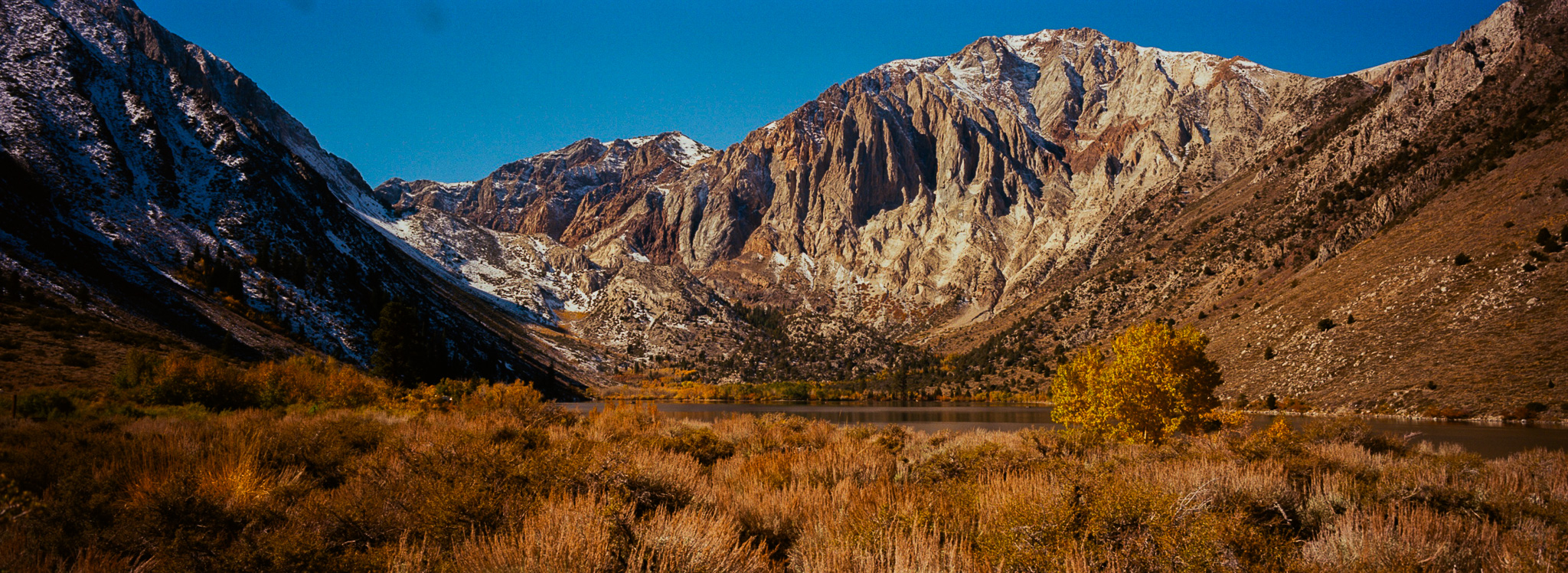
In autumn 2025 I drove up Highway 395, slept in Bishop, and went into Mammoth Lakes to photograph autumn color against fresh snow. It was my first field outing with the 4×5. I had a 90mm lens, color Ektar and Ilford black-and-white film, and two holders. Four sheets. My notes afterward were enthusiastic about the camera and considerably less enthusiastic about how I had prepared to use it.
Four exposures is a very small working supply
The trip wasn't exclusively large format. I made sunset photographs with the XPan on the drive up, carried the RB67 with a 360mm for the mountains and a 50mm for wider views, and also shot with the Sony a7R. But the four-sheet limit belonged specifically to the 4×5. Once I had used those holders, continuing meant dealing with film loading, rather than simply making another exposure.
There is a tempting story to tell about that constraint: scarcity makes every picture deliberate. My actual action item was to buy more holders. I wanted enough capacity to respond to what was there, test an alternative, or make another exposure without turning the next photograph into a loading problem. Being deliberate and being underprepared can feel similar in the moment. The equipment list afterward makes the difference fairly clear.
The missing loupe left a question I couldn't answer
I also went without a loupe for checking focus on the ground glass. The note I wrote afterward was simple: I hoped the photographs were sharp. That is the part I want to remember accurately. I didn't come back knowing I had missed focus. I came back without enough confidence in the check I had made.
Those are different problems. A soft negative gives you a result to diagnose. Uncertainty means the process didn't give you a reliable answer before you exposed the sheet. My follow-up was to get a loupe, test it with the camera at home, and make it part of the field kit. The plan for reviewing the returned negatives began with focus, before deciding which pictures deserved better scans.
Exposed film needed an unambiguous home
Film handling was the other weak point. My notes called for a separate box for exposed film and a clearer separation between exposed and unexposed material during loading. The concern wasn't an elaborate archival system. It was being able to tell, without hesitation, what I had already photographed and what was still available to use.
That belongs in the preparation for the trip, alongside lenses and film stocks. A holder, a box, and an agreed place to put something can remove a surprising amount of uncertainty. I don't want to arrive at a changing landscape and spend my attention reconstructing the state of my own equipment.
The trip continued after the drive home
The next steps in the record were development, checking the negatives, identifying scan candidates, and getting the pictures into an organized archive. I was also beginning to think about returning repeatedly to the Bishop and Highway 395 corridor. A place I wanted to keep photographing needed a process I could repeat.
I loved working with the 4×5. That part of the trip is clear in the notes. So is the less romantic conclusion: bring more loaded holders, check focus properly, separate the exposed film, and make a plan for what happens when it comes home. I would rather carry those lessons into the next trip than turn four available exposures into a philosophy of photography.
Share this entry